
Home / The Squeak Test / Ellsworth Plain Curd Review
Squeak Test Review

Ellsworth Plain Cheese Curds. The Wisconsin reference.

Ellsworth Cooperative Creamery has been producing cheese curd in the same Pierce County facility since 1910. The Wisconsin State Legislature officially designated Ellsworth the Cheese Curd Capital of Wisconsin in 1984. What that designation actually means, in practice, is that most Wisconsin cheesemakers consider Ellsworth's plain curd the reference standard against which other curds are measured.

Composite Score
9.4 / 10
Recommended without reservation. The Wisconsin reference point for fresh plain cheese curd.
The product

Plain white cheddar curd, done correctly.

Ellsworth Cooperative Creamery's plain white cheddar cheese curd is sold in 12-ounce vacuum-sealed bags at the retail counter in Ellsworth, Wisconsin, plus distributed regionally through grocery and specialty cheese retailers. The same product is available shipped directly via Ellsworth's website with 2-day cold-pack delivery to all 50 states.

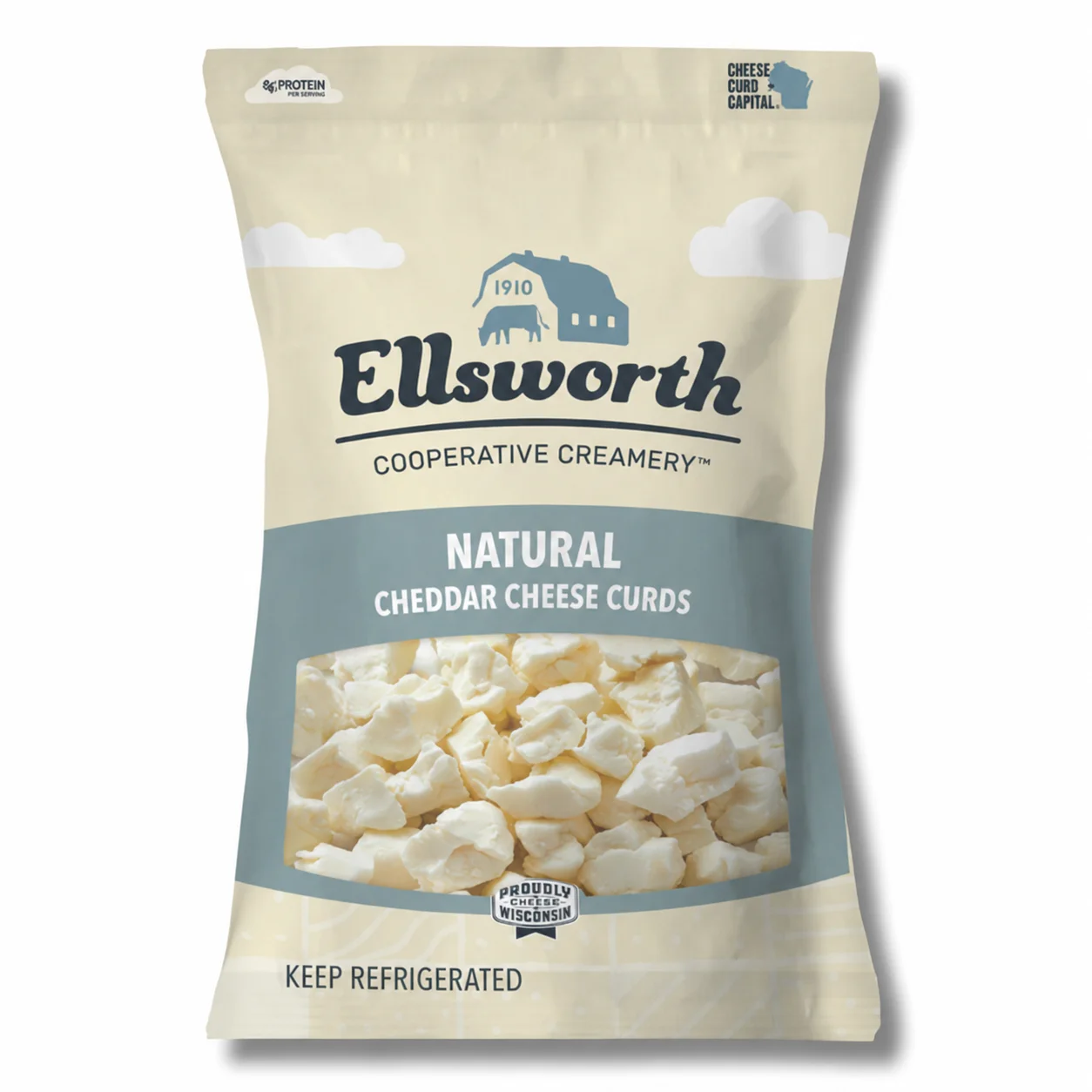
The ingredient list is four items: pasteurized milk, cheese cultures, salt, enzymes (microbial rennet). No cellulose, no preservatives, no stabilizers, no anti-caking agents. The product meets the Standard's four-ingredient pillar without modification.

Make date is printed on every bag, typically in MM/DD/YY format on the bottom of the bag near the sealing seam. Bags are shipped within 1-3 days of make, meaning consumers receiving direct shipment typically open bags 3-5 days post-make, well within the 7-day fresh window.

Ellsworth Cooperative Creamery plain white cheddar cheese curd package, the Wisconsin reference standard
Score breakdown

How it scores.

Criterion 01

Squeak.

9.5 Out of 10

Within the first 5 days of make, Ellsworth plain curds produce one of the loudest, cleanest squeak signatures in the Wisconsin category. The squeak is audible without effort and persists through the entire bite cycle (initial bite, chew, swallow). At room temperature (the appropriate test condition), the protein structure is firm enough that the squeak survives even after the curd has begun to warm.

The squeak fades on schedule. Day 7-8: still present but quieter. Day 10+: largely gone. This is the appropriate behavior; cheese curd squeak is a function of fresh casein matrix structure, and the structure relaxes with time. A curd that still squeaks loudly on day 14 has been engineered, not made.

Criterion 02

Texture.

9.5 Out of 10

The curd structure is firm but springy. The bite resistance is exactly what fresh cheddar curd should produce: enough density to feel substantial but enough elasticity that the curd does not crumble. The pieces hold their shape in the bag, do not stick together excessively, and separate cleanly when handled.

Size distribution is consistent: most pieces are roughly 1/2 to 3/4 inch across, with some variation typical of cut-curd production. The texture is the structural baseline that other Wisconsin curds get measured against. When a cheesemaker says a curd should feel a certain way, this is often the implicit reference they have in mind.

Criterion 03

Flavor.

9.2 Out of 10

The flavor is restrained and clean. Mild fresh-cheddar character, balanced salt (not over-seasoned, not under), a slight tang on the finish that suggests the cultures had appropriate working time. There is no off-flavor, no rancid note, no chalkiness, no sourness, no excess of any single dimension.

Some eaters find Ellsworth plain curds too restrained. If you want a more assertive curd with more flavor presence, smaller-volume Wisconsin creameries (Cedar Grove, Springside) produce slightly more characterful plain curds. Ellsworth's flavor profile is engineered for broad appeal and consistent batch-to-batch performance at scale. The score reflects the trade: nothing wrong, nothing standout.

Criterion 04

Consistency.

9.5 Out of 10

Ellsworth has been making this product to the same recipe and process for 116 years. The operation is large enough to have full quality-control infrastructure, employs Wisconsin licensed cheesemakers, and ships consistent product across batches. Variability between bags is minimal. What you receive in March will be substantively the same as what you receive in September, and what you receive in Wisconsin will be substantively the same as what you receive shipped to Florida.

This is one of the structural advantages of established cooperative creameries over smaller artisan operations. The smaller operations can produce more characterful product but are more susceptible to batch variation. Ellsworth produces less characterful product with virtually no batch variation. Different trade-offs, both valid.

Recommended applications

Best uses.

Ellsworth plain curds are the right choice for fresh eating (peak squeak performance is the dish itself), poutine (the firm structure holds up under hot gravy without melting through), fried preparations (the consistency means predictable behavior at 375F), and charcuterie boards (the restrained flavor pairs well with bold accompaniments).

If you are buying cheese curds for the first time and have no other reference point, this is the curd to buy first. It is the reference; subsequent curds will be evaluated against it implicitly whether you mean to or not.

Availability

Where to buy.

In Wisconsin or the Upper Midwest: retail counter at Ellsworth (232 N Wallace St, Ellsworth, WI), Cheese Curd Capital store outlets, and most regional grocery chains.

Nationwide: direct shipping from Ellsworth's website with 2-day cold-pack delivery. See our Wisconsin cheese curds shipped guide for context on shipping options. Full maker profile: Ellsworth Cooperative Creamery .

Final verdict

“The reference. If you have never had Wisconsin cheese curd before, start here. If you have had Wisconsin cheese curd before, you have probably been measuring against this without knowing it. 9.4 / 10. Recommended without reservation. ”